
Graham County Parole and Probation Differences
North Carolina assigns state community supervision to the North Carolina Department of Adult Correction, or NCDAC. Probation is a court-imposed sentence and can exist without a state-prison term. Post-release supervision follows qualifying structured-sentencing prison terms. Parole mainly applies to legacy sentences and other categories made eligible by law. A county-jail bond or time-served release is not parole merely because the person has left the detention center.
| Status | How it begins | What release means |
|---|---|---|
| Probation | A court imposes supervision, sometimes instead of prison. | The person may never have entered NCDAC prison custody. |
| Post-release supervision | It follows a qualifying prison term under structured sentencing. | Physical prison release and active supervision coexist. |
| Parole | It applies under the controlling sentence law, often for older or specially eligible cases. | Release is conditional until discharge or another recorded outcome. |
The sentence date and governing law matter. No single eligibility fraction or label safely describes every North Carolina record.
How to Verify Graham County Post-Release Supervision
The NCDAC Offender Search is the official first route for a North Carolina state supervisee. Its scope includes state prisoners, probationers, and parolees, with history reaching back to 1972. It does not include a Graham County jail-only episode. Search by offender number whenever possible because it separates people with similar names.
- Choose the status search and enter the NCDAC offender number, or use name with birth, age, race, gender, or other matching data.
- Open the correct detail record only after comparing the available identifiers and aliases.
- Read the incarceration and supervision statuses separately. “Active Probationer/Parolee” means the person is in the community and currently supervised by NCDAC.
- Review the supervision type, office, conviction information, movement history, and actual or projected release fields supplied by the live record.
- Verify the listed office through NCDAC Community Supervision, since supervision can move between counties.
An “Inactive” state record means the person was formerly active in the state system. It does not by itself prove why custody or supervision ended. Absence from NCDAC also does not prove that a Graham County Detention Center booking never occurred.
Note: Use the Sheriff transaction for a Graham jail release and the NCDAC detail for state incarceration or supervision.
Graham County Supervision Record Fields
A detailed NCDAC record can bring several parts of the sentence together. Readers should still treat each field according to its label instead of turning one date into a broad claim of full discharge.
| Field | What it can establish |
|---|---|
| Offender number and aliases | Stable matching data for separating similar names. |
| Incarceration status | Whether the state prison part is active or inactive. |
| Supervision status and type | Whether probation, parole, or post-release supervision remains active. |
| Probation/parole office | The unit shown on the live record, subject to confirmation and later transfer. |
| Projected and actual release dates | Planned and recorded state-prison release events, not a Graham jail timestamp. |
| Sentence and movement history | Terms, offenses, locations, admissions, and movements maintained by NCDAC. |
A documented example in the research shows inactive incarceration with active post-release supervision and an actual release date. That combination demonstrates why “released” cannot be paraphrased as “fully discharged.” The image below comes from the official NCDAC offender detail.
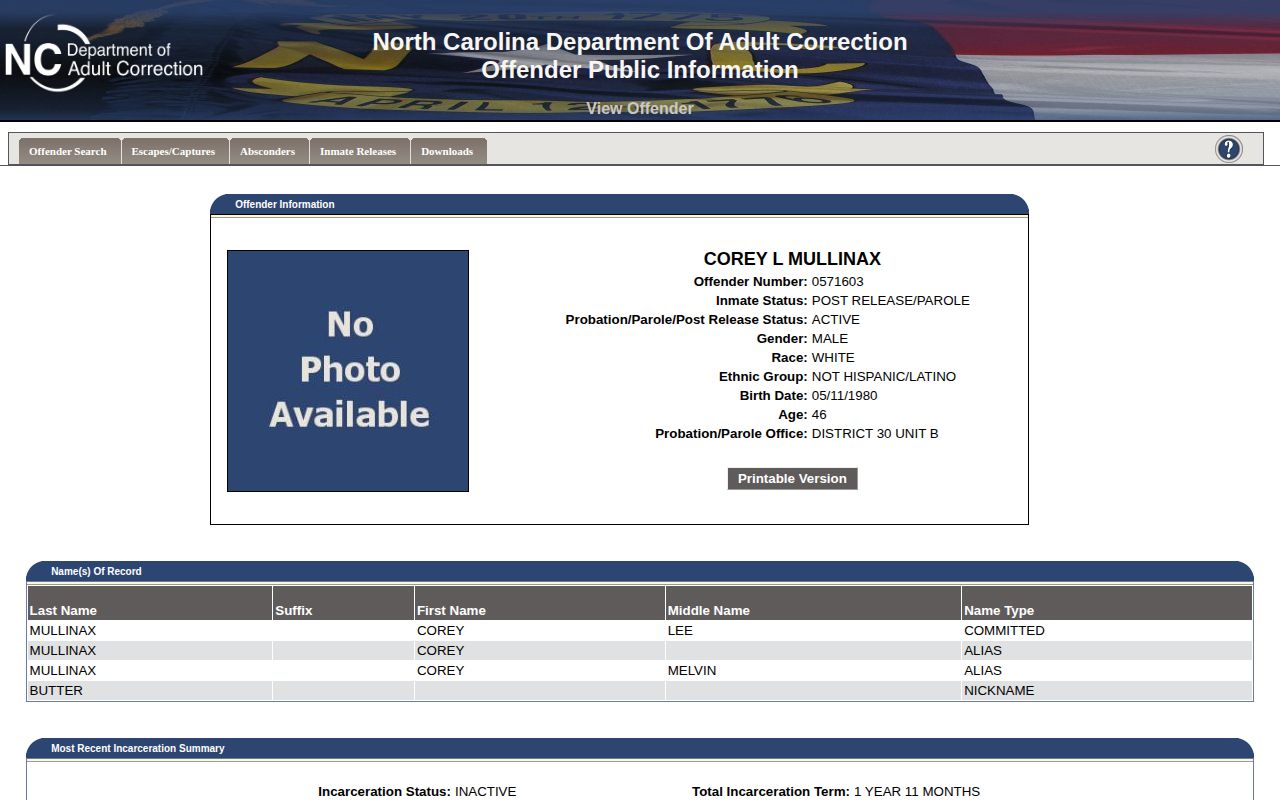
The separate status lines and date fields allow a careful reader to distinguish prison release from continuing supervision.
Graham County Supervision Office Confirmation
A conviction in Graham County does not guarantee that a Graham office currently supervises the person. Residence, transfer, and case administration can place supervision elsewhere. The live NCDAC record may identify a district and unit. Confirm that listing with the statewide Community Supervision directory or the agency before relying on an old address.
North Carolina Community Supervision
Agency: North Carolina Department of Adult Correction
Public route: Community Supervision directory
Records contact: NCDAC c/o Public Information Office, MSC 4202, Raleigh, NC 27699-4202
Website questions: webmaster@doc.state.nc.us
For certified or authenticated records, ask NCDAC for the proper records channel. A screenshot or website printout is useful for routing and verification but is not automatically a certified supervision record.
Graham County Absconded Probationer Search
NCDAC maintains a separate Absconded Probationer Search. It accepts a last name and county of supervision. “Absconded” means the person failed to remain available to supervision. The label alone does not establish an arrest, a revocation, a new criminal charge, or admission to prison.
Search the current offender record after finding an absconder entry. Then examine the official court file for later action and contact the supervising unit when authorized information is needed. A warrant or violation proceeding may change custody without appearing everywhere at the same time. The official absconder search screen is shown below from its NCDAC source.
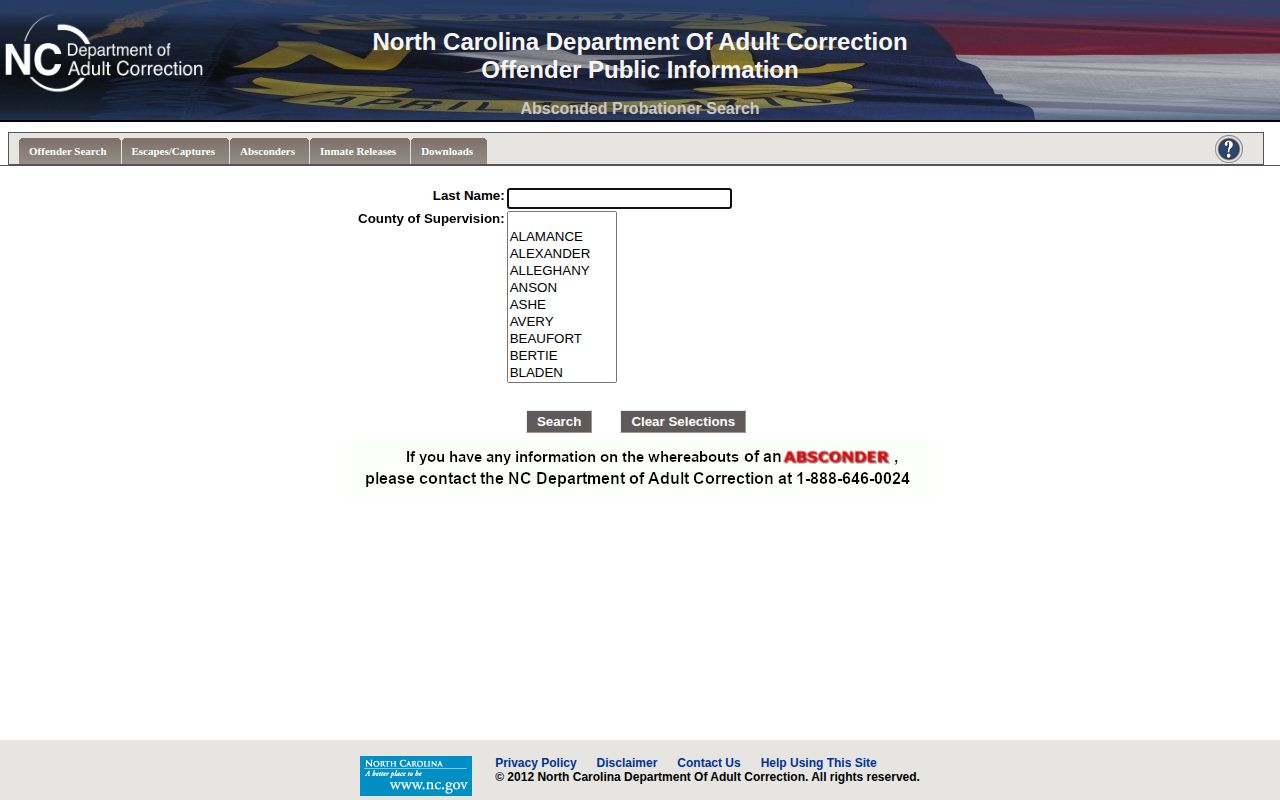
The county field refers to supervision, so it should not be mistaken for the county of conviction, arrest, or present custody.
Graham County Parole Review Records
The North Carolina Post-Release Supervision and Parole Commission handles post-release and legacy discretionary-parole matters. North Carolina does not provide the conventional public calendar of formal, in-person offender hearings that readers may expect from another state. The Commission states that it does not hold formal hearings or personally meet with offenders in that conventional format.
The proper public schedule-and-results channel is the Commission’s monthly Discretionary Parole Reviews. Use the wording in the applicable monthly publication rather than forcing generic outcome labels onto a North Carolina case. Eligibility under G.S. 15A-1371 depends on the offense date, sentence, minimum term, credits, category, and any special rule. For a named person, start with the offender number and then ask the Commission when the monthly material does not resolve the case.
A parole review publication is not the same record as an NCDAC release date, a supervision status, or a Sheriff jail-release transaction.
Graham County Supervision and VINE Alerts
North Carolina VINE can supply custody and notification events from participating agencies, including certain state-prison and supervision events. It can be useful when a person’s custody status may change, but it is not a certified supervision or release record. Select the actual facility or agency record and do not assume that a Graham jail entry and an NCDAC entry are the same source.
For a pending custody change, register only after matching the correct person. Phone registration may require a four-digit PIN to acknowledge a call, while text or email may require confirmation. The focused VINE Inmate Check explains that process. A missing VINE result can reflect timing, coverage, or matching limits, so follow up with the supplying custodian.
Correcting a Graham County Release Record
When a Sheriff release record contains an error, identify the exact Graham County booking and the disputed field. Attach the court order, release document, or other source that supports the correction and send the request to the record custodian. Avoid asking the office to create a new narrative. A precise request gives the custodian a booking number, name, dates, and the field that needs review.
If an expunged item remains with a covered private criminal-history compiler, G.S. 15A-152 provides a deletion-notice and personal-verification path when its conditions apply. That process differs from correcting an NCDAC status or a Sheriff booking field. The originating office remains the first source for the public record it maintains.
When Graham County Supervision Ends
Physical release ends one custody stage. Discharge ends the supervision obligation recorded by the responsible agency. A person can leave Graham County Detention Center on bond while the court case continues, leave state prison into post-release supervision, complete probation without a prison term, or receive a later discharge from parole. Those events call for different proof.
Use NCDAC for the state supervision record, the Commission for Commission matters, the Graham County Sheriff for a local booking transaction, and Portal or the Clerk for the court case. The Graham County Courthouse page confirms the local Clerk route, while the county records page explains why Sheriff-held material goes to that elected official. Graham County’s full named-person release workflow is covered on the released-inmate search page. Reconcile the records before saying a sentence, case, or custody obligation is complete.
A supervision end date should be read with the status and sentence to which it belongs. If the online detail remains unclear, identify the offender number and exact period in a request to NCDAC. Court orders may explain a modification or revocation, while the agency record shows how community supervision was administered. Keep copies of the source pages and note the date checked because office assignments and active statuses can change. No single jail, court, VINE, or Commission screen supplies every part of that history.