
Graham County Projected and Actual Release Dates
A projected date is an administrative estimate based on the sentence and information known at that time. An actual release date records a completed release event in the responsible system. NCDAC may display both for a state prisoner, along with movement, sentence, offense, and supervision data. Graham County does not publish a comparable online jail-release field set.
A jail booking can end through bond, time served, another lawful discharge, or transfer. A state-prison term can end in release with post-release supervision. A federal custody result may say released or not in BOP custody without resolving supervision or another custodian. The date must stay attached to the system that produced it.
| Date or status | Meaning |
|---|---|
| Projected release | A calculated or expected state correctional date that can change. |
| Actual release | The state system’s recorded completion of the release movement. |
| Graham jail release timestamp | The Sheriff’s local booking endpoint, available by direct inquiry or request. |
| Court disposition date | A legal case event that may not equal physical release processing. |
How to Find a Graham County Projected Release Date
Begin by identifying the custodian. Graham County Detention Center is a county jail. NCDAC operates the state prison and supervision system. BOP, ICE, and the U.S. Marshals address distinct federal custody types. A search of the wrong system can produce no match even when the person remains confined elsewhere.
- For a state prisoner, open NCDAC Offender Search and use the offender number when possible.
- Compare name, birth data, aliases, demographics, offense, and location before selecting a record.
- Read the projected and actual release fields, sentence detail, last movement, and present incarceration or supervision status together.
- For a Graham County jail sentence, call the Jail Captain at 828-479-8650 and ask for the proper records route. Check the court judgment for the imposed term and credit.
- For a pretrial detainee, review bond and later orders in North Carolina Portal or with the Graham County Clerk.
- Verify a pending event with the custodian. A web date is not an appointment or pickup guarantee.
The Graham County released-person workflow on the home search page helps determine whether the local booking ended in community release or transfer.
Graham County NCDAC Release-Date Fields
The official state detail inventory includes the offender number and aliases; incarceration and supervision statuses; conviction and sentence dates; projected and actual release dates; last movement and location; minimum and maximum terms; and release or parole fields when applicable. These records cover NCDAC prisoners, probationers, and parolees, not county-jail-only information.
A research example shows inactive incarceration, an actual prison release, and active post-release supervision at the same time. The official NCDAC detail illustrates that distinction.
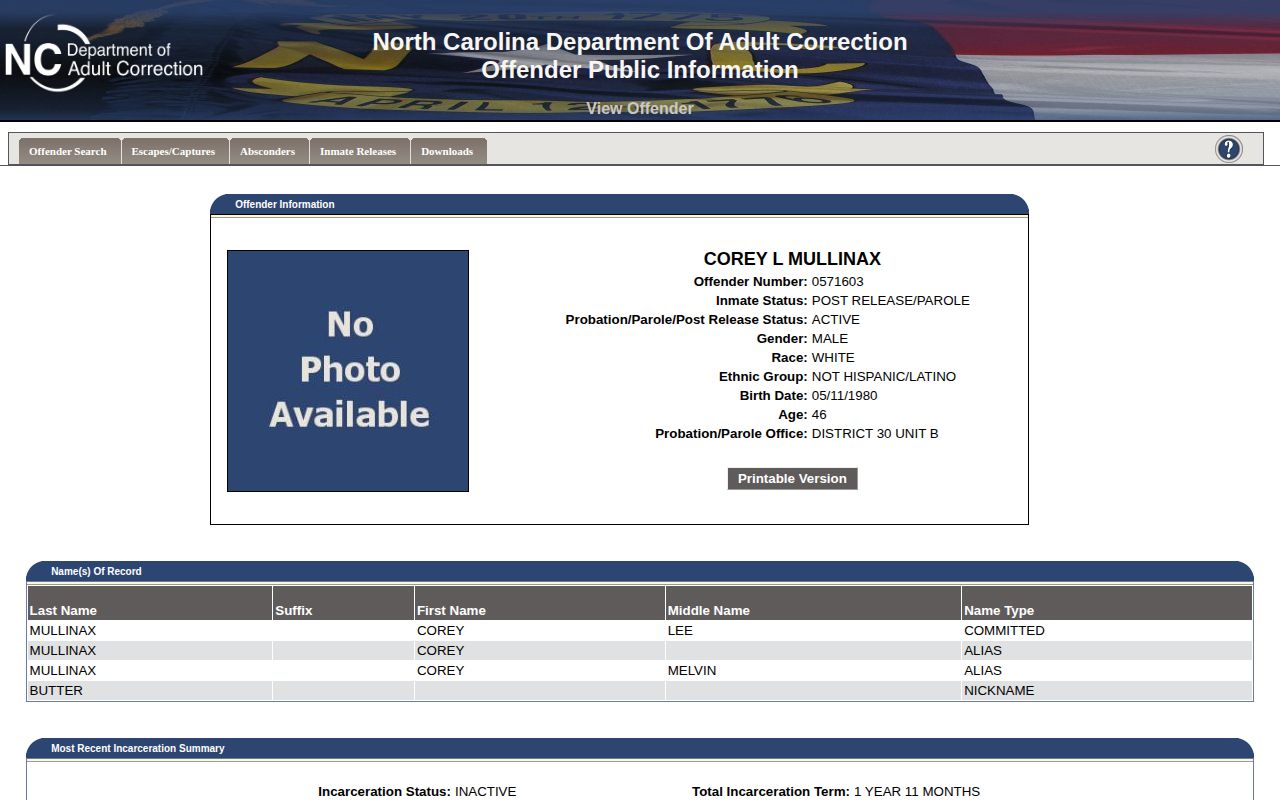
The record demonstrates why an actual prison-release date should not be summarized as complete discharge from every supervision duty.
NCDAC also provides an Inmate Release Search with county, year, month, other-state, not-reported, and last-name controls. Selecting Graham as release county refers to the state record’s destination. It does not identify everyone who left Graham County Detention Center.
Graham County Good-Time and Earned-Time Rules
North Carolina structured sentencing does not support a simple claim that every prisoner serves exactly 85 percent. The often-repeated approximation comes from the relationship between minimum and maximum terms and the limits placed on earned time. A responsible calculation follows the actual statutes and NCDAC rules rather than promising a fixed percentage.
G.S. 15A-1340.13 governs active felony terms. It provides that the minimum term must be served, subject to authorized jail credit and other rules, while earned time can reduce the maximum term but not below the minimum. G.S. 15A-1340.20 supplies the misdemeanor framework. G.S. 15A-1355(c) authorizes qualifying prisoners sentenced under Article 81B to earn credit under DAC rules.
The official felony framework is visible in the General Assembly statute page.
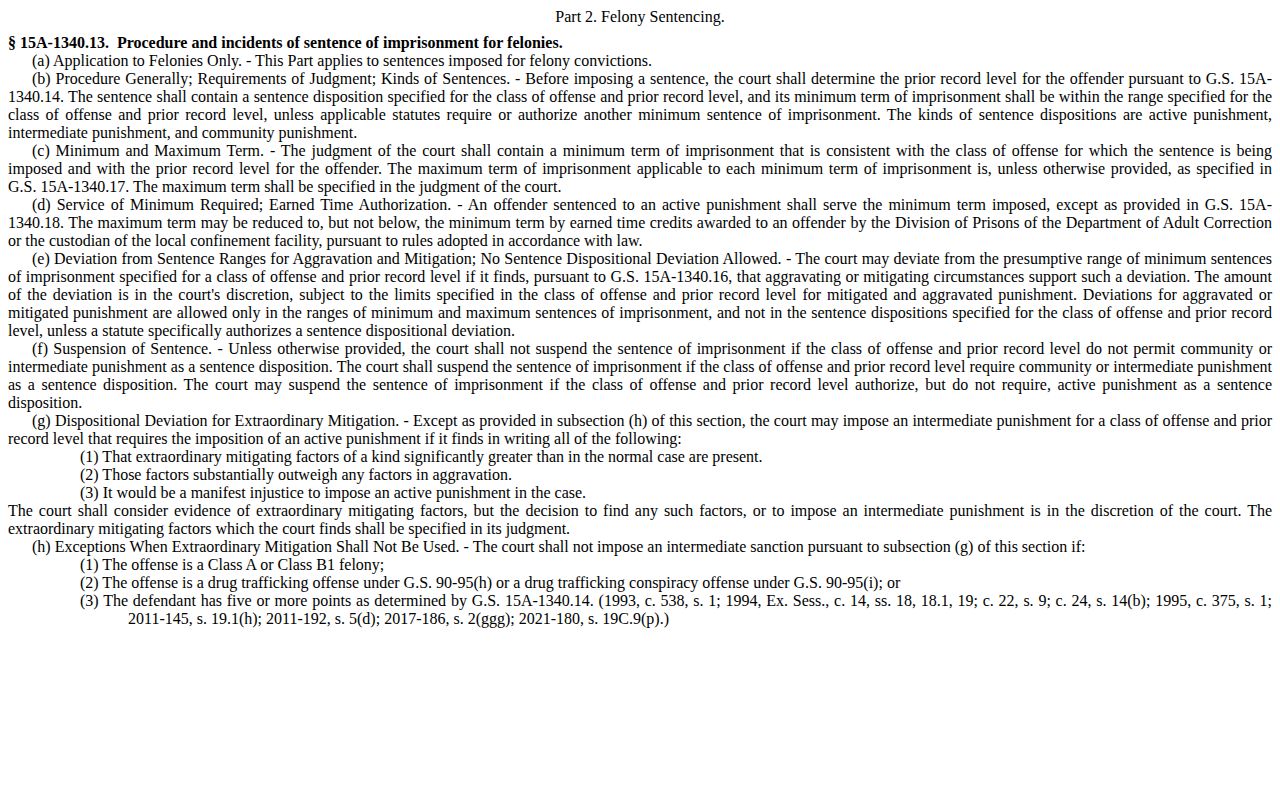
The minimum-term floor and earned-time limits explain why a projected date must be tied to the individual sentence, not a slogan.
Graham County Jail Credit Calculations
G.S. 148-13 has a direct local importance. Subsection (e) requires DAC earned-time and good-time regulations to be distributed to and followed by local jail administrators for sentenced prisoners. A person can therefore have a Graham County jail calculation affected by state rules even if that person never enters an NCDAC prison.
The statute does not establish a published Graham-only weekend, holiday, or door-release practice. None was verified. Ask the Jail Captain about the existing calculation and ask the Clerk for the judgment and credit reflected in the court record. If the figures conflict, identify the specific sentence, docket, booking, and disputed credit rather than asking either office for a new legal conclusion.
Note: State credit rules can apply in the local jail, but no unpublished Graham release practice should be assumed.
What Changes a Graham County Release Date
A date can move for reasons found in correctional, court, and warrant records. Some changes affect the calculation, while others block the expected community transition even when the original sentence date arrives.
| Factor | Possible effect |
|---|---|
| Jail credit | Authorized time already served can alter the remaining term. |
| Earned credit | Credit under DAC rules may reduce the maximum within statutory limits. |
| Credit loss or restoration | Disciplinary decisions can move the administrative estimate. |
| Sentence correction | An amended judgment or corrected data can require recalculation. |
| Concurrent or consecutive terms | The relationship among sentences changes the endpoint. |
| Detainer, warrant, or another sentence | The person may move to another custodian instead of entering the community. |
| Appeal or later court order | Judicial action can alter the basis for custody. |
G.S. 148-10.5 requires NCDAC to work to identify outstanding warrants at intake and before release. That check can interrupt an expected transition. The resulting transfer is not a release to the community even though one custody entry ends.
Graham County Pretrial Release Has No Set Date
A pretrial detainee has not received a final active sentence calculation. Release may follow satisfaction of bond, dismissal, a court order, or judgment. The Graham County local rules page publishes a bail and pretrial-release policy, but no simple public dollar schedule or county pretrial-services program was confirmed.
Use North Carolina Portal for the case record, or contact the Graham County Clerk at 828-479-7000. The courthouse page confirms the local office, and the Sheriff page supplies the jail contact. Magistrates can be reached at 828-479-7019. A bond order does not prove that bond was satisfied or that jail processing finished at the same moment. The Sheriff record establishes the physical Graham booking endpoint, while the court record explains the legal event.
Confirm a Graham County Jail Date
Graham County publishes no online roster, released view, 24-hour list, 72-hour list, or booking-detail archive. Call the Graham County Detention Center for immediate routing, then request the existing booking and release transaction from the Sheriff for durable proof.
Graham County Detention Center
Address: 11 Court St, Robbinsville, NC 28771
Jail Captain: 828-479-8650
Mail: PO Box 622, Robbinsville, NC 28771
Sheriff administration: 828-479-3352
Identify the full name, date of birth, approximate admit and release dates, and booking number if known. Ask for the admit timestamp, release timestamp, release type or destination if recorded, charges and commitment data attached to that booking, and transfer agency when the person did not enter the community. Request an electronic copy and an advance estimate before an extraordinary-service charge.
The Graham County public-record page provides the general request framework. Because the Sheriff is an independent elected official, route Sheriff-held jail records directly to that office.
Graham County Release Date and Supervision
Leaving state prison can begin post-release supervision rather than end the sentence. NCDAC’s Active Probationer/Parolee status means the person is present in the community under state supervision. Probation can also begin without prison. Legacy parole depends on the governing law and does not follow one universal eligibility formula.
Check the offender detail for the supervision type and listed unit, then verify the office through NCDAC Community Supervision. The Commission’s monthly Discretionary Parole Reviews are the correct public publication for applicable parole-review matters; North Carolina does not publish a conventional calendar of personal offender hearings. The separate Post-Release Supervision guide explains how those records fit together.
Graham County Release Alerts and Federal Dates
North Carolina VINE can provide prospective notifications from participating county and state sources. Register against the correctly matched person and agency before the expected event. A VINE alert is useful corroboration but does not replace the Sheriff transaction or NCDAC actual-release field.
For federal sentenced custody, use the BOP Inmate Locator. It generally covers records from 1982 forward and can show release date and location, but BOP warns that recalculation can change dates. ICE’s locator covers current and certain recently released detainees using an A-number or biographical search. A federal or immigration “release” does not establish arrival in Graham County and can instead reflect transfer, removal, or another authority.
When a date appears in more than one system, compare the agency, event label, and time period before treating the records as inconsistent. A projected NCDAC date, a VINE alert, and a court judgment can describe different stages of one case. Preserve the offender or booking number with each result. If a new hold appears, the expected release may become a transfer, and the receiving agency becomes the next source to check.